
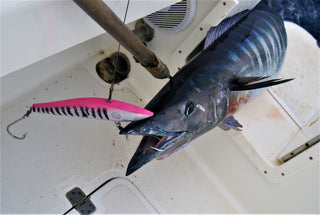
Most missed strikes offshore have nothing to do with bad luck. They happen because the lure looked wrong for the water it was running in.
The ocean is messy. Currents twist and shift. Water clarity changes minute by minute. Wind pushes your spread in directions you didn’t plan. Yet a lot of anglers keep throwing the same lure the same way all day. And when the fish stop biting? They assume the fish aren’t there. They are. You just aren’t speaking the language of that day, that water, that current.
Adjusting lure movement to match conditions turns slow days into productive ones. It makes the difference between casting all day with nothing to show and walking back to the dock with fish in the box.
How Lure Action Decides Whether Fish Commit or Fade
Fish respond to movement first, not flash or color. A lure that swims too slow, too fast, or erratically will get ignored. Subtle tweaks can trigger strikes or keep fish following without committing.
Mahi, for example, loves fast, sharp darting motions. They’ll chase a fluttering lure across the surface. Tuna? They often prefer a smooth, steady swim with a few quick twitches. You notice these differences when you watch carefully. For example, one boat you fished with had the same lure spread all day. The mahi barely moved. Swapped to a slightly twitchier setup, and suddenly fish everywhere.
Using mahi lures designed to hold action in variable currents keeps you in the game. If your lure collapses or spins in the wrong way, even the most aggressive predator hesitates. It’s a small detail, but it’s the difference between a strike and a follow.
Reading Current and Water Clarity
Current changes everything. Even a slight drift can ruin a lure’s action. Too strong and the lure swims erratically. Too weak and it looks lifeless. You have to feel it in your hands and watch it. Adjust speed, rod motion, and sometimes line length. Small changes, huge results.
Water clarity is another story. Clear water? Fish can scrutinize a lure for a long time. Move too unnaturally, and you’ll get nothing. Murky water? Bigger splash, exaggerated motion. Fish rely on sight but also reaction. You want to give them something they can see and something that feels “right.”
Offshore anglers swap lures like mad sometimes. A lure that worked two hours ago can be completely ignored later. That’s where Wahoo fishing lures shine- they hold their action across changing currents and water clarity. You swap, you see results. Sometimes it’s trial and error. That’s okay.
Depth and Weather Change the Game
Depth is huge. Surface lures are great when fish are up, but move deeper, and they often ignore it. Thermoclines and bait schools dictate how deep predators hunt. Adjust your lure’s depth with line length, trolling speed, or heavier gear. Small tweaks matter.
Wind? Chop? Barometric pressure? All change the predator behavior. Fish often get cautious under overcast or choppy conditions. Smooth retrieves help. Too aggressive and you spook them. Too slow and they don’t even notice.
If you’re unsure, contact us. It’s faster than wasting hours guessing. Advice from someone who’s been on that water makes all the difference.
Building a Spread That Works in Any Condition
A good spread covers multiple depths and actions. Don’t rely on one type of retrieve. Mix fast darts, smooth glides, and subtle twitches. Watch what happens. Adjust. Keep notes.
Even small adjustments- rod angle, line speed, slight twitch- can turn a slow lure into a strike magnet. Watching your spread is a skill. The ocean doesn’t stay still. Predators don’t either. You want your spread to cover the bases and give them something irresistible.
You can also think of your spread like a conversation with the fish. Each lure is sending a different “signal,” and predators respond differently depending on mood, current, and nearby bait. Sometimes one lure will trigger aggressive strikes while another is completely ignored.
Watching how the fish react to each action- and being ready to tweak retrieve speed, rod motion, or lure depth- lets you adapt in real-time.
Putting It All Together
Matching lure movement to conditions is simple in theory, hard in practice. Currents, clarity, depth, wind- they all affect how a lure behaves. Predators notice these differences. You should too.
Lures that are built to maintain their action across conditions make this easier. Magbaylures designs stay true in rough currents, deep water, or choppy surfaces. That way, you can focus on observing, adjusting, and striking at the right time.
Spend a day watching, adjusting, and noting what works. You’ll see the difference immediately. Missed strikes turn into aggressive hits. Followed lures turn into hooked fish. The ocean gives feedback. You just need to read it and respond.